
sales@screwjackfactory.com, screwjackfactory@gmail.com +86-137-1229-1184
English

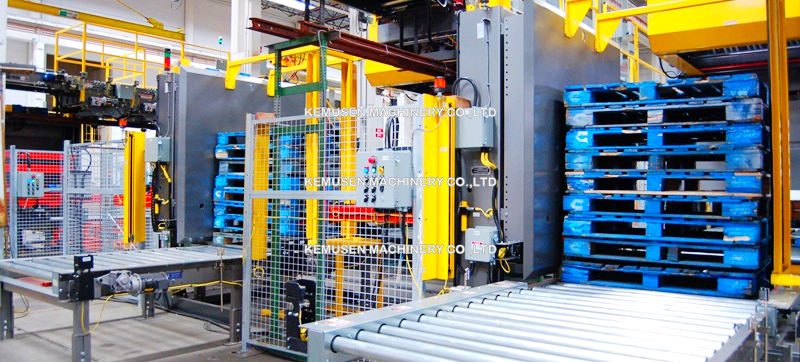
Screw jacks are used in palletizing machines to provide the precise and reliable linear motion needed for the vertical movement of products or empty pallets. They convert the rotational motion from a motor or manual input into a controlled linear push or pull.
Why screw jacks are used in palletizers
Compared to hydraulic or pneumatic systems, screw jacks offer several benefits in palletizing applications:
Precision and synchronization: Screw jacks can achieve very accurate and repeatable positioning. In multi-jack systems, multiple units can be interconnected with shafts and gearboxes to move in perfect synchronization, even with unevenly distributed loads.
Holding stability: Many types of screw jacks are inherently self-locking, meaning they can hold a heavy load in position indefinitely without "creeping" or needing external locking devices.
Robustness and reliability: With a simple and rugged design, screw jacks provide reliable lifting and positioning, requiring minimal maintenance. They are also less prone to leakage issues that can affect hydraulic systems.
Versatility: They can be manually or motor-powered, accommodating a wide range of speeds and loads, and can be configured with various mounting options.
Applications in palletizers
Layer lifting: In many palletizers, products are accumulated on a "layer table". A screw jack system lifts this entire layer to a specific height, allowing a robotic arm or pusher to slide it onto the pallet.
Platform and conveyor lifting: Screw jacks can adjust the height of a conveyor line or a pallet-loading platform to accommodate different sized products or pallets. In a high/low pallet conveyor system, for example, they can lift a loaded pallet on one deck while another is processed on a lower one.
Pallet dispensing: In a pallet dispenser, a screw jack raises a stack of empty pallets. It holds the stack at the second-from-bottom pallet, allowing the lowest pallet to be released and moved into position for loading.
Adjustable guides and fences: Screw jacks offer the controlled positioning required for adjusting side guides and fences. This allows the palletizing machine to accommodate and align different sizes of cases or bags accurately.
Types of screw jacks used
Translating screw jack: This is the most common type for palletizers. The lifting screw moves linearly through the gearbox as it is rotated, pushing or pulling the load. An attached load or external guide prevents the screw from rotating. Translating screw jacks are the most common type used in palletizers because they provide a simple and robust solution for precise, synchronized vertical lifting. They are ideal for applications where a common load, or external guides, can prevent the lifting screw from rotating.
Rotating screw jack (traveling nut): In this configuration, the screw itself rotates but does not move vertically. The lifting nut, to which the load is attached, travels up and down the length of the screw. This is useful when the screw's extension space is limited. Rotating screw jacks, also known as traveling nut jacks, are primarily used in palletizing applications where there is limited space for the screw to extend and retract. In this design, the lifting screw rotates in place, and a flanged nut travels along the screw to provide linear motion.
Keyed screw jack: A keyway is built into the lifting screw and housing to prevent rotation, ensuring that the screw translates linearly without needing a guided load. Keyed screw jacks are used in palletizers when the load being lifted or positioned is not attached to the screw and requires anti-rotation control to ensure precise, straight linear motion. This is critical for applications where the product orientation must be maintained or the lifting mechanism is freestanding.


